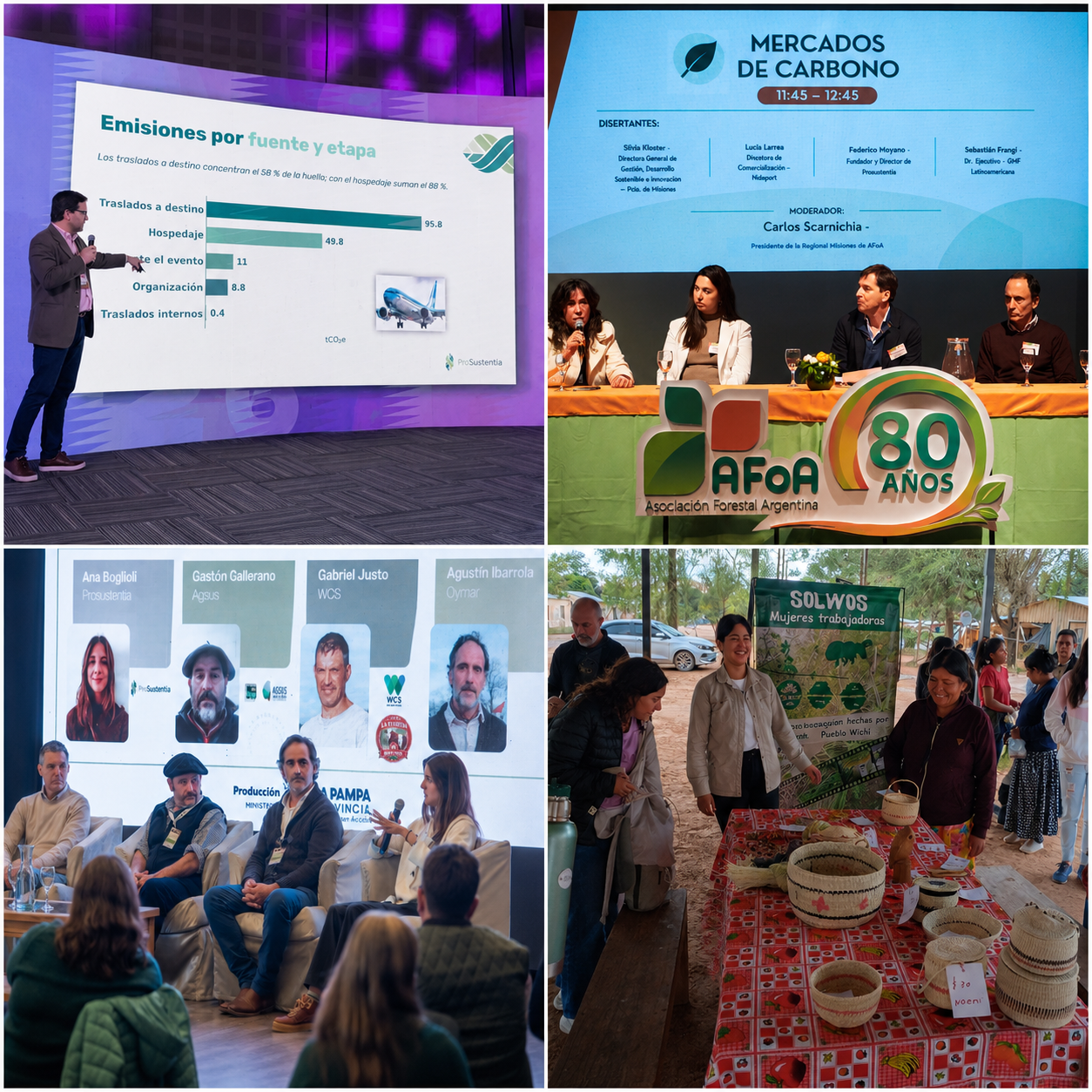
Throughout August, ProSustentia participated in various meetings that brought together leaders from the private sector, companies, public agencies, communities, and experts to discuss a common challenge: how to incorporate climate action and carbon management into a wide range of activities and sectors.
From agricultural, livestock, and forestry production to event planning and the development of conservation projects, the various sessions provided an opportunity to share experiences and introduce tools related to emissions measurement, carbon markets, and Nature-Based Solutions.
Carbon, Sustainability, and Value Addition for Agriculture in the Pampas
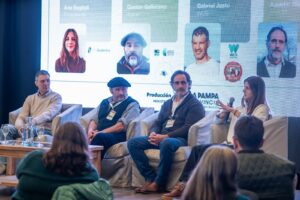
In La Pampa, we participated in the 1st Conference on Carbon, Sustainability, and Value Addition for the Pampas Agricultural Sector, an event that brought together more than 200 people to discuss the opportunities and challenges presented by the carbon agenda for the agricultural sector.
Representing ProSustentia was Ana Boglioli, Technical Manager for Agricultural and Livestock Projects (ALM), who shared our team’s experience in developing and certifying carbon projects applied to agricultural and livestock systems. Drawing on real-world examples related to regenerative agriculture and livestock farming, Ana explained how management practices, outcome measurement, and the validation and verification processes necessary to move toward generating carbon credits are coordinated.
The event brought together representatives from the public and private sectors, producers, technical experts, and specialists, creating a forum to discuss how emissions measurement, carbon management, and the incorporation of sustainability criteria can be linked to production and value addition in agricultural supply chains.
From Measurement to Offsetting: Meet Up Argentina’s Carbon Footprint
We also attended Meet Up Argentina 2026, one of the country’s leading gatherings for the meetings and events industry.
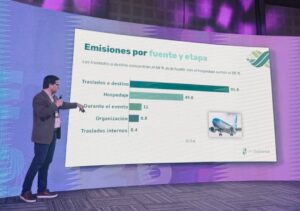
In this context, Jan Heinrich represented ProSustentia and gave a presentation titled “Carbon-Neutral Events,” in which he discussed the steps necessary to manage the emissions associated with an event: measuring its carbon footprint, identifying opportunities for reduction, and offsetting remaining emissions through carbon credits.
ProSustentia’s participation was not limited to the talk. Our team calculated Meet Up Argentina’s carbon footprint and will coordinate the offsetting of its emissions using credits from certified carbon projects. In this way, the event itself will provide an opportunity to put the concepts presented during the workshop into practice and to obtain specific information about the main sources of emissions associated with its organization.
Carbon Markets and Opportunities for the Forestry Industry
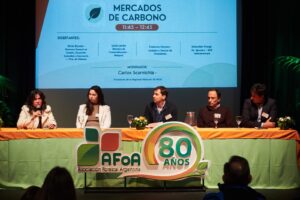
On August 21, we also participated in the Seminar marking the 80th anniversary of the Argentine Forestry Association (AFoA), held in Posadas, Misiones. The meeting brought together representatives from the public and private sectors to discuss investments, competitiveness, international markets, infrastructure, and the opportunities presented by the transition to a decarbonized economy for the forest-based industry.
Federico Moyano, director of ProSustentia, participated in the panel discussion on carbon markets, along with representatives from the private sector and the government of Misiones. During his presentation, he discussed measurement and certification standards and Argentina’s potential to develop Nature-Based Solutions (NbS) projects.
As part of the analysis, he presented a scenario in which, if just 10% of the potentially available land were incorporated into this type of project and an average value of USD 20 per credit were assumed, Argentina could generate more than USD 1 billion annually in revenue from carbon credits over the next 20 years, not counting the investments required to develop the projects.
The activities were complemented by technical tours of forestry and industrial facilities in Misiones and Corrientes, where participants were able to learn about initiatives related to forest management, carbon sequestration, wood processing, and biomass-based energy generation.
Carbon, Biodiversity, and Community in the Gran Chaco Region of Salta
On August 19 and 20, we returned to Salta to participate in another session of the Argentina Gran Chaco Region REDD+ Project (VCS ID 4513), which protects nearly 5,000 hectares of native forest in the Gran Chaco. At ProSustentia, we provide technical support to Aike throughout the project’s certification process under Verra’s VCS and CCB standards, drawing on our expertise in AFOLU projects, carbon, biodiversity, and social aspects. In 2026, the project made progress on its first VCS verification and CCB validation.
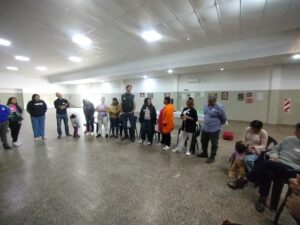
Miguel D’Ambrosio, Biodiversity Analyst and Head of CCB Certification, participated on behalf of ProSustentia. The first day included activities in General Pizarro with women who participated in the Personal Development and Leadership Course, as well as a visit to the Wichí Eben Ezer community, where we learned about initiatives developed in partnership with the Aike Foundation and the work of the artisans from the Solwos group, who create pieces using chaguar fiber.
The next day, the activities moved to Finca El Chaguaral, where we spent the day with representatives of the Wichí community, educational institutions, local authorities, farmworkers, and teams from Vista, Aike, GMF, and the Aike Foundation. There, we took part in a planting of native species and a ceremony honoring Pachamama.
These initiatives allow us to supplement our technical work with a firsthand understanding of the region, its stakeholders, and its dynamics. In projects that aim to demonstrate results under the Verified Carbon Standard (VCS) and verifiable benefits for the climate, communities, and biodiversity through the Climate, Community & Biodiversity Standards (CCB), engagement with local stakeholders and monitoring of socio-environmental aspects are central to the certification process.
Different Sectors, a Common Challenge
Although these were events involving very different audiences, regions, and activities, the four experiences share a common thread: carbon management is increasingly being integrated into production, business, and regional decisions.
At ProSustentia, we value these forums as opportunities to share experiences and technical tools, but also to exchange perspectives with those who are putting these challenges into practice in different sectors and regions.