

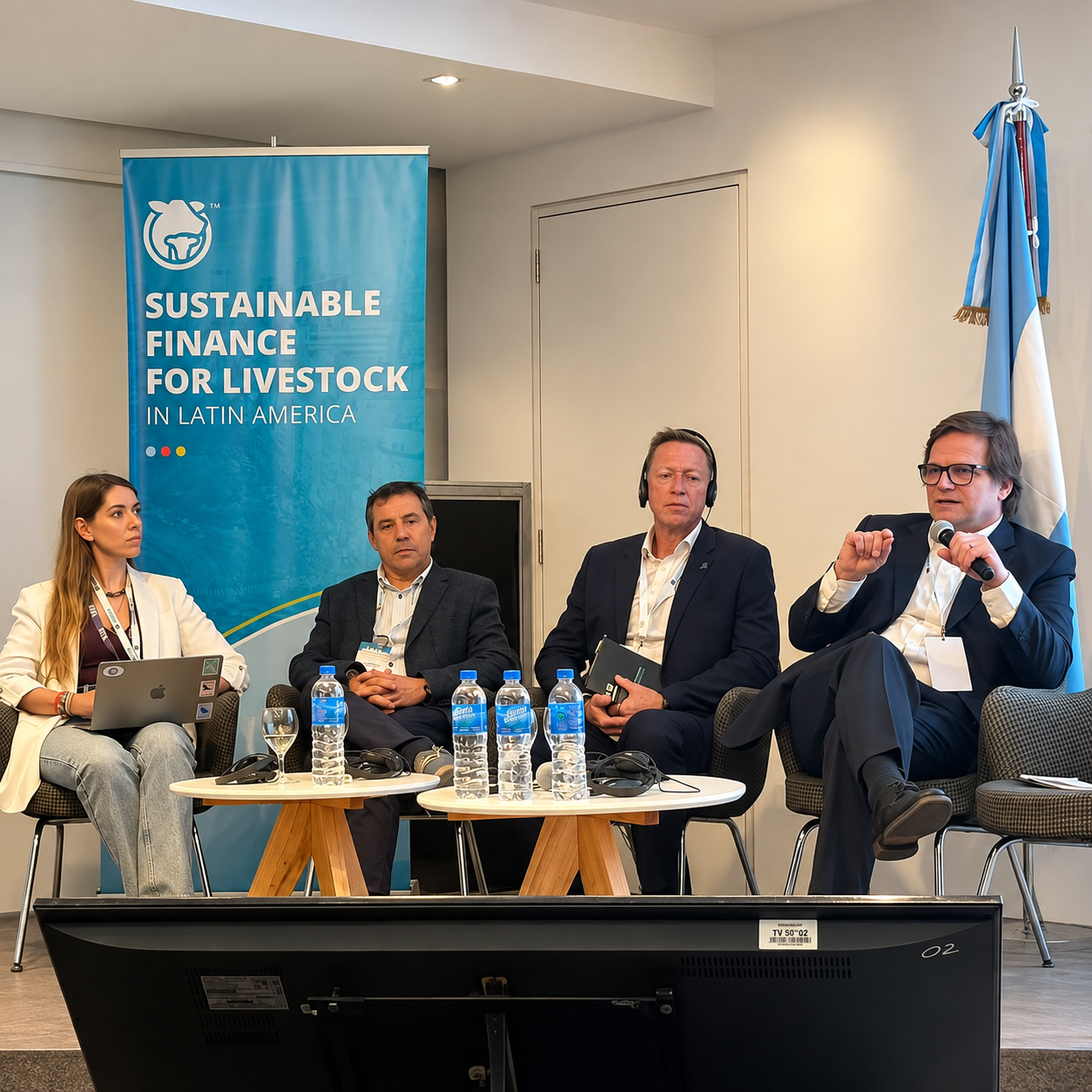
How can we finance the transition to more sustainable livestock systems? This was one of the central questions at the “Sustainable Finance for Livestock in Latin America” conference, organized by the Global Roundtable for Sustainable Beef (GRSB) in Buenos Aires.
The event brought together key players in the meat value chain, financial institutions, producers, and experts to explore ways to channel investment toward more sustainable production systems.
Representing ProSustentia, Jan Heinrich participated in the panel dedicated to carbon projects as a financing mechanism for sustainable livestock farming. During his presentation, he addressed in particular the potential of clustered projects , a model that allows different producers and farms to be included under the same certification structure.
Why group projects?
Developing and certifying a carbon project involves costs related to design, establishing baselines, monitoring, validation, verification, and the issuance of credits. For certain facilities, bearing the full cost of this process individually can jeopardize the project’s economic viability.
Grouped projects allow for greater scale and enable some of those costs to be shared among different participants. Each new area must meet the established eligibility criteria and methodological requirements, but it can be incorporated into an already developed project structure.
In agricultural and livestock activities, this model can facilitate the participation of producers who implement practices aimed at reducing emissions or increasing carbon stocks, and generate a supplementary source of income linked to the climate outcomes achieved.
Carbon credits do not replace traditional financing, nor do they alone provide the investments needed to transform production systems. However, when there is a technically sound project with quantifiable and verifiable results, they can become an additional component of a long-term financing strategy.
From Discussion to Concrete Projects
This conversation is directly related to projects that ProSustentia is currently supporting in Argentina.
In Fortín Farías, in the province of Buenos Aires, the first phase of the “Improved Agriculture Land Management in Argentina” cluster project—developed by Aike and registered under Verra’s VCS standard—is being implemented. Across 2,540 hectares, agricultural and livestock practices such as crop-livestock rotations, cover crops, regenerative livestock management, and improvements in pasture management are being implemented, with the goal of increasing soil organic carbon.
The clustered nature of the project allows for the gradual incorporation of new areas that meet the eligibility requirements, thereby expanding its scale and establishing the infrastructure necessary for certification.
Another example is the project developed by BERCA at Estancia Ralicó in Córdoba, with technical support from ProSustentia. There, practices such as rotational grazing in caldén woodlands, perennial alfalfa with no-till farming, no-till seeding, and cover crops are combined to improve livestock management and increase soil organic carbon.
Both experiences demonstrate how carbon certification can be integrated into real-world production systems and transformation processes that require planning, investment, monitoring, and continuity over time.
Financing the transition requires a combination of tools
The transition to livestock and agricultural practices with a lower climate impact requires investments that often exceed the capacity of a single funding source.
Credit, private investment, sustainable financial instruments, public programs, and carbon markets can play complementary roles.
The challenge is to identify which practices generate measurable climate outcomes, which mechanisms enable the financing of their implementation, and under what conditions those outcomes can be robustly certified.
At ProSustentia, we work on the design and certification of agricultural and livestock carbon projects, assessing their feasibility, the applicable methodologies, and the conditions necessary to translate productivity improvements into quantifiable and verifiable climate outcomes.